Why Is Medicare Charging Me Thousands More?
By popular demand—and after several “Wait, what is this bill?” phone calls—I’m posting this article. A number of women were shocked to discover that enrolling in Medicare could come with thousands of dollars a year in additional charges called IRMAA. Most had never heard of IRMAA, and they certainly didn’t realize that it could apply to both them and their spouse. I’m writing this article so you won’t be caught off guard—and so you can take steps now to prepare for, reduce, or possibly avoid IRMAA.
The Hidden Medicare Surcharge: IRMAA
You may be surprised to learn that if your retirement income exceeds certain levels, you’ll pay additional monthly premiums (known as IRMAA—Income-Related Monthly Adjustment Amount) to the federal government for Medicare Part B and Part D.
Standard Medicare Premium in 2026
For 2026, the standard Medicare Part B premium is $202.90 per month.
This is what most people pay to the federal government, in addition to any premiums for:
A Medicare Supplement plan and prescription drug plan; or
A Medicare Advantage plan
What Is IRMAA?
IRMAA is an extra charge added to your Part B and Part D costs if your Modified Adjusted Gross Income, or MAGI, exceeds certain thresholds.
IRMAA is recalculated each year and is based on your income from two years earlier. Therefore, your 2026 IRMAA is based on your 2024 federal tax return.
For IRMAA purposes, MAGI means your adjusted gross income plus tax-exempt interest income.
2026 IRMAA Brackets for Part B & Part D
These amounts are monthly and apply to each Medicare beneficiary.
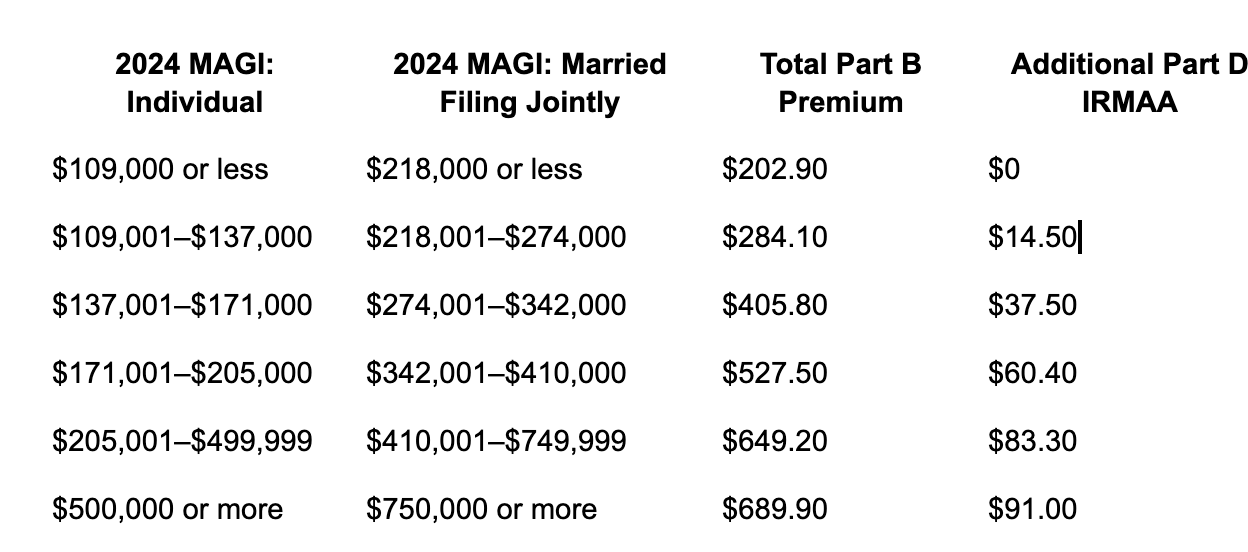
Key Things to Know
If your MAGI exceeds a threshold by even $1, you may move into the next IRMAA tier.
If both spouses are enrolled in Medicare, each spouse pays IRMAA.
The Part D IRMAA charge is added to your regular prescription drug plan premium.
IRMAA is separate from your Medicare Supplement or Medicare Advantage premium.
Can You Avoid or Reduce IRMAA?
You may be able to lower your IRMAA by reducing your Modified Adjusted Growth Income (MAGI). Here are a few strategies worth discussing with your tax advisor:
Use Roth Accounts
Withdrawals from Roth IRAs or Roth 401(k)s do not count toward IRMAA, whereas withdrawals from traditional 401(k)s or IRAs do. Another reason I’m a big Roth fan.Manage Capital Gains
Capital gains count toward MAGI. When taking money from mutual funds, consider selling those with the highest cost basis, or timing distributions to minimize gains.Delay Social Security
The taxable portion of your Social Security benefits is included in MAGI. Delaying benefits until age 70 may reduce your taxable income in earlier years.Appeal IRMAA
If your income has significantly dropped since the reference year (e.g., you retired, spouse died, etc.), you can appeal the IRMAA determination. How to Appeal IRMAAWork with an Accountant or Tax Advisor
Withdrawals from traditional 401(k)s and IRAs, Roth conversions, and selling stocks, mutual funds, or a house can all affect your MAGI. If part of the gain from selling your house is taxable, it could increase your IRMAA by thousands of dollars two years later—even if the higher charge lasts for only one year. A professional can help you plan these transactions before you cross an IRMAA threshold.
If you’d like to make the best Medicare decision for you or your parents watch Medicare:What the Insurance companies won’t tell you.
Medicare open enrollment for 2027 opens October 15 to December 7 2026.